Sustainable Procurement and Supplier Management Policy

GRI 2-23, 2-24, 3-3

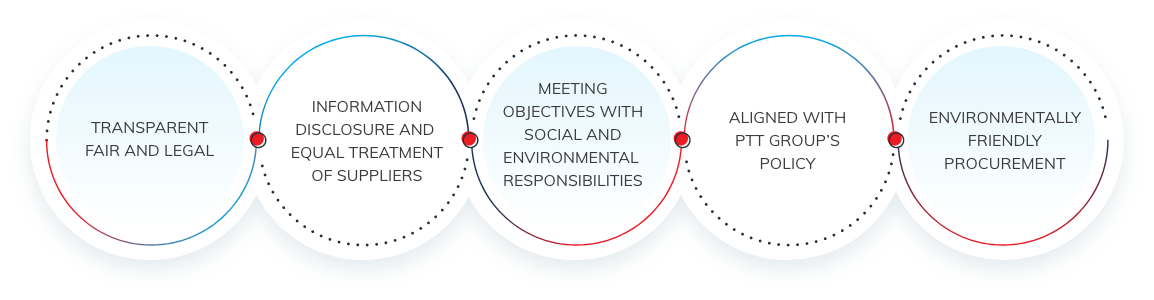
GPSC is committed to the effective procurement and management of su pplies, insurance, and other aspects of operations related to business sustainability. The company introd uced the Sustainable Procurement and Supplier Management Policy to ensure excellence in procurement with transparency, fairness, and alignment with global practices.

See materiality assessment from link

Sustainable Procurement and Supplier Management Policy

Supplier Sustainable Code of Conduct

GPSC partners can be classified into two main categories:

  • Raw material suppliers: These partners provide the company with essential raw materials such as natural gas, raw water, purified water, and other necessary inputs. PTT Public Company Limited is a key supplier in this category.
  • Service providers: This category encompasses a wide range of partners that offer various services to the company. These include design and construction contractors, equipment and machinery suppliers, and maintenance and repair contractors.

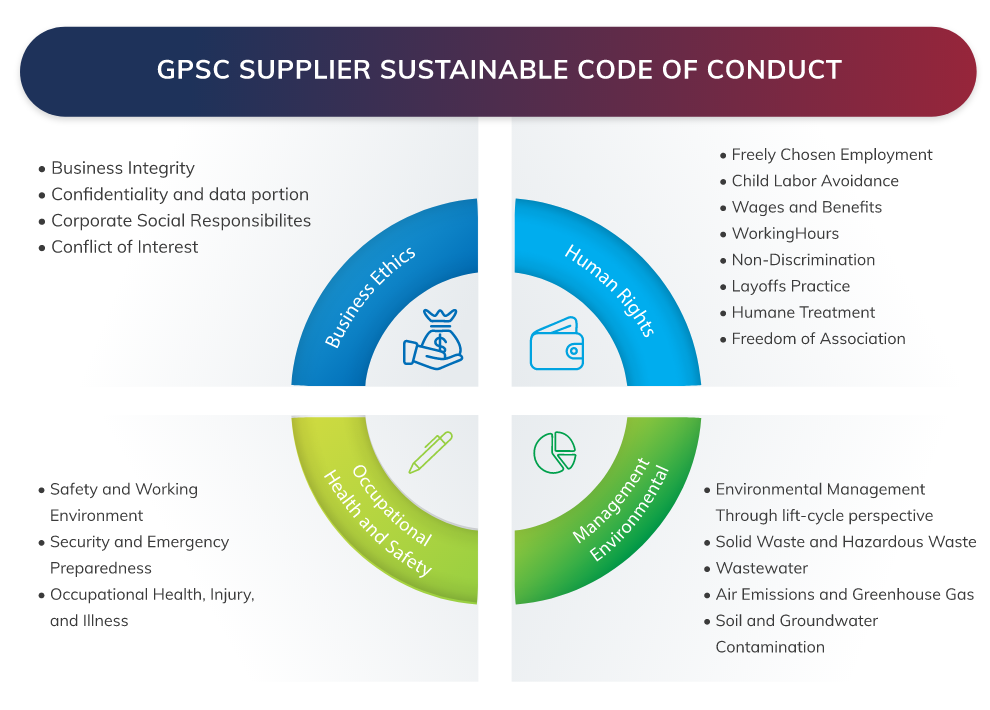
GPSC recognizes the importance of encouraging suppliers to uphold governance principles with social and environmental responsibilities in their business operations. Therefore, the company created the Supplier Sustainable Code of Conduct to communicate the rules which require strict compliance by suppliers. The content of the Supplier Sustainable Code of Conduct ranges from business ethics, human rights, to safety, and environmental management.

Supplier Sustainable Code of Conduct

Supply Chain Management : Vision – Missions – Goals

Vision 2020-2024
  • Be a Preferred and Trusted Partner of GPSC Group Users
Missions
  • P - Process Compliance & Good Governance
  • P - Proactive Procurement
  • E - Effective Procurement
Goals
  • Saving
  • Supplier Management
  • Process Development

Supply Chain Management Approach

GRI 2-23, 2-24, 3-3
GPSC Supply Chain Management

Organizational structure – Supply Chain ESG Management Implementing supplier ESG program

GPSC assigns Board of Directors (BoD) to oversight the overall implementation of the supplier management and supplier ESG program to ensure alignment of vision and implementation which is critical to drive the successful outcomes, and to guarantee maximal priority and focus. Board oversight tasks are delegated to the Corporate Governance and Sustainability Committee as well as Risk Management Committee.

The President and Chief Executive officer (CEO) is responsible to oversee the supplier ESG program implemented under the supervision of EVP-Corporate Services (PSE) and the key responsible function – Strategic Procurement and Warehouse (PPS) and Strategic Procurement (PGM)

The purchasing practices towards suppliers are also continuously reviewed by PPS & PGM to ensure that the business demands, and expectations are aligned with the GPSC Supplier Code of Conduct, and ESG requirements. After the review process is completed, the progress and results will be reported to PSE and higher levels hierarchically.

In 2022, GPSC has implemented the projects improving the purchasing practices to keep aligning with ESG trend and increasing the procurement efficiency, such as Supplier registration on Supplier Portal Program, which supplier must pass the ESG Assessment.

GPSC has implemented a Supplier Portal since 2022 and continuously improved the support functions in 2024 to enhance procurement practices in supplier management and ESG Risk Screening. The portal was developed as a single platform for supplier data collection, registration and communication including bidding and general announcement.

Suppliers can register and login to update their information and be able to perform following actions in the portal;

  • Registration and update information
  • Document submission (e.g. company affidavit, Statement, ISO and other certificates etc.)
  • Perform ESG Risk self-assessment.
  • Critical Non-tier 1 identification
  • Understand and acknowledgement of GPSC Sustainable Supplier Code of Conduct
  • Acknowledgement of GPSC terms and conditions
  • Acknowledgement of GPSC practices toward Personal Data Protection Act (PDPA)
  • Evaluate the need of Data Processing Agreement (DPA)

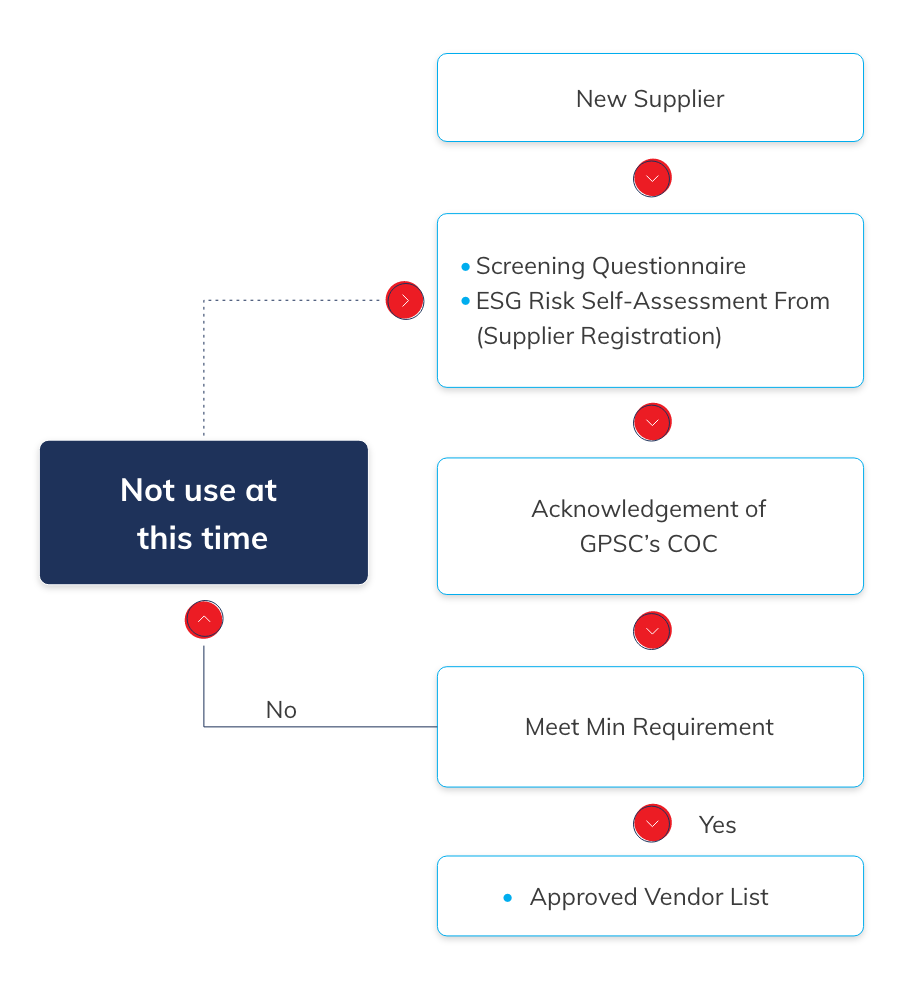
Supplier registered to Supplier Portal shall pass through the Pre-Qualification Process and get the approval from related parties and automatically interface register to SAP S4Hana; GPSC’s New ERP, directly. This step helps shorten the registration process and ensure the completion of information and document.

The score of ESG Risk self-assessment shall be summarized and downloaded by supplier in which GPSC shall consider the final score as the pre-risk screening score for supplier pre-qualification process.

Supply Chain Risk Management and Program Design

Supply chain risk management and program design have been implemented at GPSC to manage and assess supplier risk to prevent and mitigate environmental, social, and governance risks from anywhere along the supply chain. Implementation of the program consists of following 4 processes:

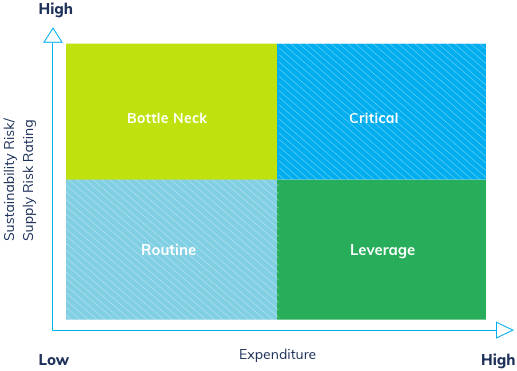
GPSC has analyzed trading partners that pose a risk to operations, including Spend Analysis, Critical Analysis, and Dependency Analysis and Dependent Analysis. The results of the analysis have been further developed to determine appropriate strategies for management by using the Supply Position Model.

1. Supply Chain Analysis

GPSC conducts the following analyses on suppliers which are deemed to pose potential risk to the business: spend analysis, critical analysis, and dependent analysis. The analytical results are used as input into formulating appropriate management strategies by applying the supply position model.

2. Environmental Social and Governance (ESG) Risk Assessment

GRI 2-23, 308-1, 414-1

GPSC assesses 100% suppliers on the likelihood and severity of environmental, social, and governance risks. Details of each dimension are as follows:

Environmental risks are greenhouse gas emissions, noise and vibration pollution, water use and waste water release, power usage, waste and hazardous materials management, and biodiversity impacts.

Governance risks are corruption, tax evasion, fair business competition, and intellectual property.

Social risks are labor management, human rights, health and safety, and legal compliance.

Supplier Selection & Pre-Risk Assessment
  • 1st Party Supplier Selection and Pre-Risk Assessment
  • ESG Risk Self-Assessment
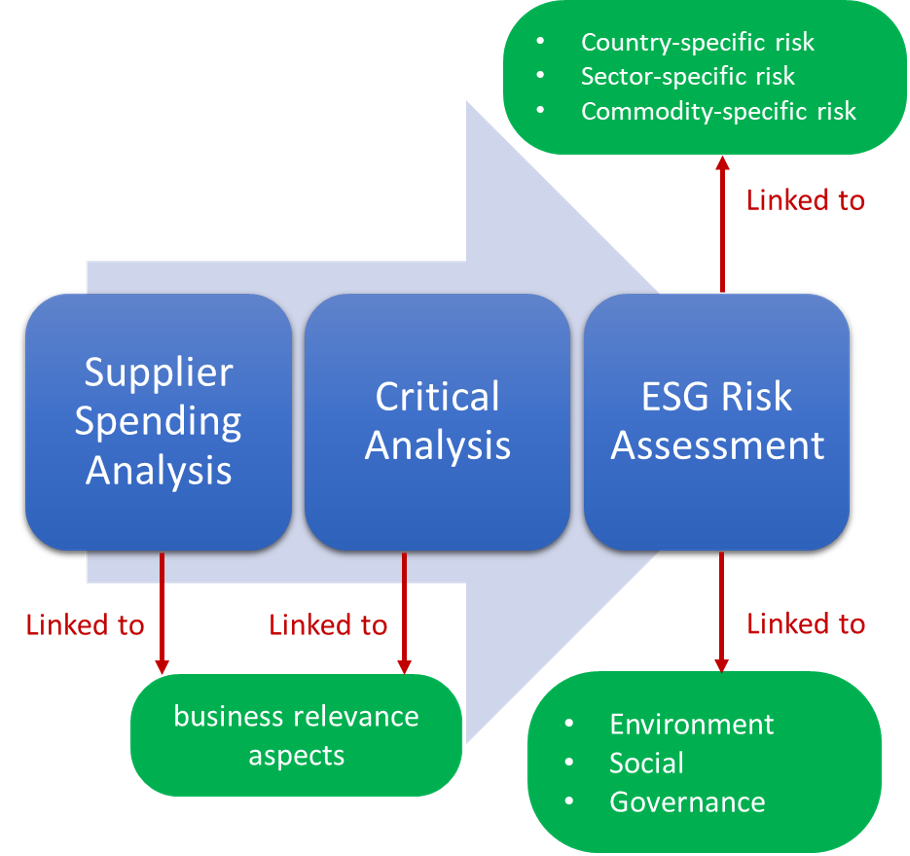
Supplier Characterization & ESG Risk Assessment
  • Spending Analysis
  • Critical Analysis
  • ESG Risk Assessment
Supplier Assessment
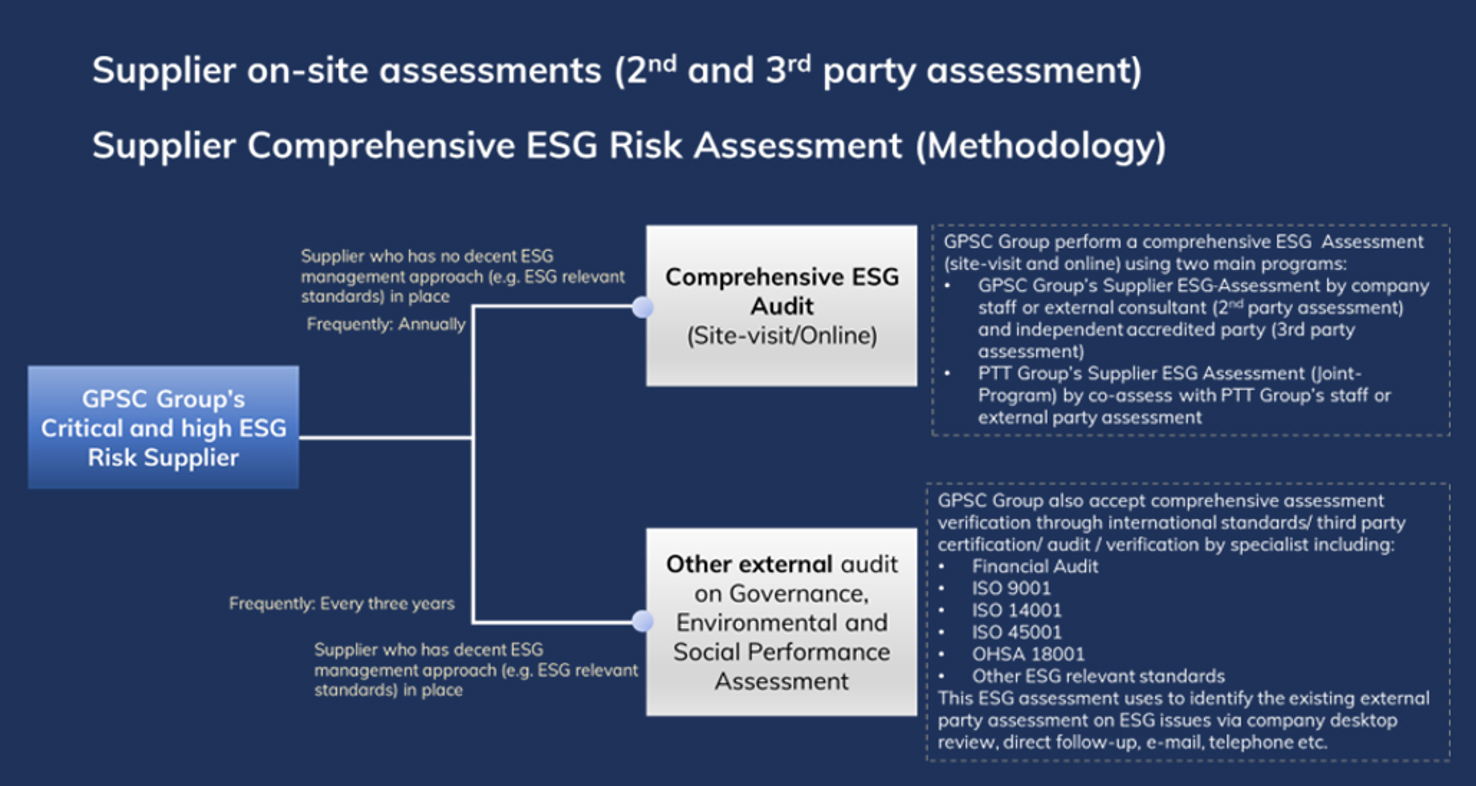
  • Supplier Comprehensive ESG Risk Assessment
    • 2nd party assessment
    • 3rd party assessment
Supplier Risk Mitigation
  • Risk mitigation and partner improvement through GPSC's programs.

*The process covers GPSC Group Tier-1 and Non-Tier 1 Suppliers

GPSC has arranged internal workshops for procurement employees or those involved in the procurement strategy section to ensure that procurement staff understand their role in the ESG risk management process in the supply chain. The workshops is organized once a year in order to review policies on sustainable procurement and management of suppliers, sustainable practices of suppliers and other related processes.

GPSC has adopted the system of vendor list and supplier selection to ensure that suppliers deliver products and services that meet the company’s requirements. The scope of assessment covers suppliers’ capabilities based on GPSC’s Criteria laid out in the ESG supplier assessment form (25% ESG weight included). Suppliers approved through the supplier selection process will be registered on the Approved Vendor List (AVL) in the SAP and Maximo system by GPSC’s procurement staff.

GRI 2-23, 308-1, 414-1

GPSC evaluates 100% suppliers using ESG assessments and overall evaluation through the supplier registration form. This will be based on the general information of the suppliers, production or service assessment, certified standards, training in security, safety, occupational health and environment management, and business operations under the principles of good corporate governance and business integrity. The supplier selection committee or supply sourcing operation officer will consider using ESG assessments with an additional supplier qualification assessment form, consisting of 6 main sections

Business (weight = 10%)

This section evaluates the business including registered capital, company history and financial status

Production (weight = 30%)

This section evaluates source of products and services, production and distribution capacities, stock and resource management

Distribution (weight = 20%)

This section evaluates distribution efficiency, time and frequency of the delivery, distribution standards

Occupational Health and Safety (OHS) (weight = 15%)

This section evaluates internal policy, management, standards on OHS issues including safety record, PPE, and quality control. By prioritizing employee well-being, adhering to safety regulations, and fostering OHS practices align with ESG focus.

After sale service & Technical support (weight = 15%)

This section evaluates support on after sale service and technical of the business and product warranty

Corporate Social Responsibility (CSR) (weight = 10%)

This section evaluates CSR policy, environmental management system and human rights. This establishes a company's commitment to ethical and sustainable practices.

Suppliers shall meet a minimum of 70% in order to get approved into GPSC Approved Vendor List (AVL)

GPSC also specifies economic, environmental, and social issues consistent with the Supplier Sustainable Code of Conduct in the General Term& Conditions. All suppliers are required to sign the acknowledgement form of GPSC Supplier Sustainable Code of Conduct to ensure compliance with the agreements and requirements.

To assess suppliers' performance, GPSC has established a supplier performance measurement procedure to be carried out with suppliers on the vendor list that deliver products or services to the company during the assessment period. The purpose of the assessment is to ensure that suppliers can deliver products and services that meet the company's needs and comply with the company's Procurement Policy.

Evaluation Criteria
Score 81 - 100% Level A: Over expectation
Score 61 - 80% Level B: Meet requirement
Score 40 - 60% Level C: Need improvement some problems
Score < 40% Level D: Unsatisfied or Disqualified

Suppliers shall also complete the ESG Risk Self-Assessment form for GPSC Group to pre-screen the ESG Risk level of supplier in the supplier selection process. The ESG Risk Self assessment comprises of 5 main sections. The self scoring level is considered based on the intensity of the ESG implementation in supplier’s company.

CRITERIA TYPE EXAMPLES OF EVALUATED TOPIC
Company System and Policy Business and Governance
  • Sustainable Development Policy
  • Environmental and Other Issues Communication Policy
  • Privacy Protection and Cybersecurity Policy
  • Anti-corruption, discrimination and harassment Policy
Business Integrity Business and Governance
  • Sustainable Development Policy
  • Environmental and Other Issues Communication Policy
  • Privacy Protection and Cybersecurity Policy
  • Anti-corruption, discrimination and harassment Policy
Society Social
  • Human Rights
  • Labour Relations
  • Social Responsibility
Occupational Health and Safety Social
  • Occupational Health and Safety
  • Security and Emergency Preparedness
Environment Environmental
  • Environmental Impact Assessment and Control Measures
  • Work Plans / Projects to Reduce Environmental Impacts
  • Environmental Training for Employees
  • Environmental Performance Data collection
  • Complaints, Lawsuit, or Convictions on Environmental Issues

After suppliers have completed their own risk assessments regarding environment, society and governance, the company We will further check the information with the selected partners to confirm its accuracy. Partners can provide information through the following channels.

  • Interview at the company
  • Sending information via email
  • Online or telephone interviews

These 2 assessment tools allow supplier desk assessments with systematic verification of evidence. The 1st assessment and suppliers’ self-assessment take the form of a questionnaire. Both GPSC purchasers and suppliers are requested to evaluate and provide information and supporting evidence (if required) on the ESG policies, practices, and performance. This information is then reviewed and analyzed, to determine the supplier's business relevance and ESG performance. These assessments result in a score that reflects a systematic verification against GPSC-established specifications and requirements, considering GPSC-specific context.  

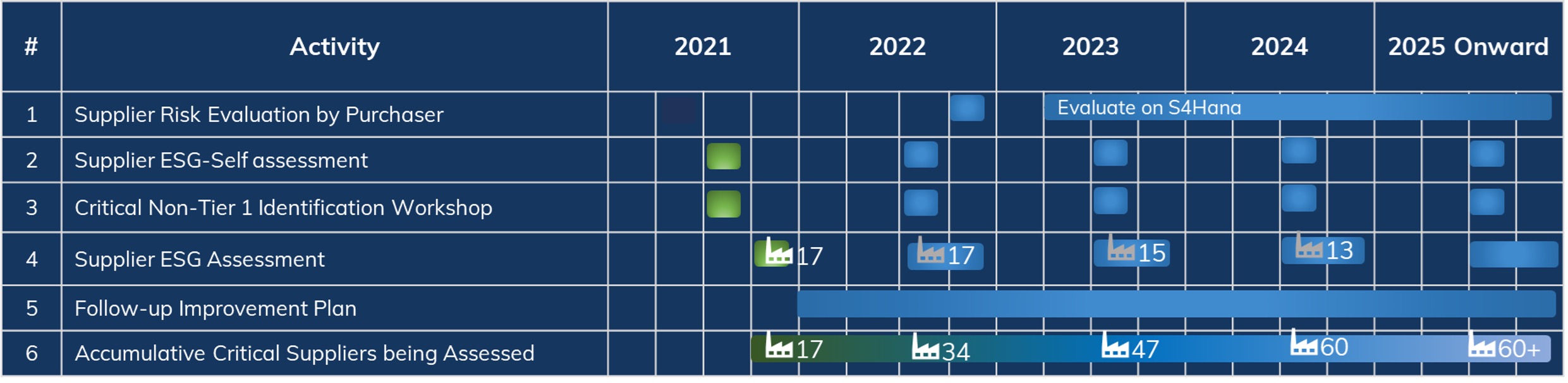
GPSC Group annually conducts the analysis on supplier spending, Critical Analysis and ESG Risk Assessment to suppliers who are deemed to pose substantial risks of negative ESG impacts or significant business relevance to the company or a combination of both. The analytical results are used as input into formulating appropriate management strategies and mitigation measures

The significant (including critical tier-1 and high ESG risk) suppliers are categorized from comply the following criteria:

  1. High expenditure
  2. Critical components
  3. Non-substitutable
  4. Strategic Relationship (Parental Company)
  5. High ESG Risk

Critical suppliers of GPSC refer to those who has high expenditure, are critical components, and non-substitutable to GPSC.

  • High-volume spending: annual spend more than 50 million baht
  • Critical component suppliers: such as feedstock suppliers
  • Non-substitutable suppliers: such as advanced construction and engineering and feedstock suppliers
  • Strategic Relationship (Parental Company) as GPSC Group's strategy and direction needs to align and comply with parental company's business strategy
GRI 2-23

High Sustainability Risk Suppliers

  • Refer to Suppliers who has high sustainability risks on the ESG issues that can cause significant both financial and non-financial impacts on GPSC Group. This includes the following criteria.
Governance

Business Ethics and Integrity, Cybersecurity and privacy protection, sustainable sourcing

Environmental

Environmental Management

Social

Employee, Human Rights, Human Development, Social Responsibility, OHS

  • Suppliers who has score =4 will consider as high sustainability risk.
ESG Risk Level Risk Management Measures
Low
  • Internal monitoring and assessment
  • Self ESG-Assessment by suppliers
Medium
Medium to High
  • Internal monitoring and assessment
  • Self ESG-Assessment by suppliers
  • Comprehensive ESG-Audit with corrective action plans
  • External Sustainability Audit
  • Supplier performance follow-up
High
In 2023, no risk issues were found from the company's trading partners.
GRI 2-23
Supplier Risk Mitigation -Comprehensive ESG Audit

To support the sustainable development of suppliers, GPSC Group performs a comprehensive company on-site to access environmental, social, and governance risks on suppliers.

The audit results are used as input into identifying solutions or ways to improve suppliers' efficiency and compliance with the Supplier Sustainable Code of Conduct. The assessment is carried out purchasing company employees or external consultant (2nd party assessment) and independent accredited auditing body (3rd party assessment).

The details of the minimum audit criteria are as follows

  • Supply Chain Management
  • Quality Standard
  • Law and Regulation Compliance
  • Business Continuity Management
  • Supplier Code of Conduct and Anti-Corruption
  • OHS
  • Environmental Management
  • Human Rights
  • Emergency Preparedness and Response
  • Social Responsibility

Findings, gaps, and recommendations will provided to supplier for improvement to meet GPSC Group's expectation where GPSC Group conducted a monitoring and follow-up based on annual basis.

Score Level Definitions
3.26 -4.00 : Excellence
Sustainability practices have been implemented at the excellent level. Monitoring is not required.
2.51-3.25 : Good
Sustainability practices have been implemented at the good level. Improvement can be achieved in some areas but monitoring is not required
1.00-2.50 : Fair
Sustainability practices have been implemented at the fair level. Suppliers must propose plan and timeline to improve performance in environmental, social, and governance area (ESG Corrective Action Plan), which has to be completed within the timeframe.
Lower than 1.00 : Poor
Implementation of sustainability is at the poor level. Supplier must propose a plan and timeline to improve performance in environmental, social, and governance area (ESG Corrective Action Plan) before any bidding can take place.

Note : The full score is 4 where suppliers must earn more or equal to 2.5 point in order to pass GPSC's ESG assessment. Suppliers who has score less than 2.5 point and do not join the improvement program to improve their ESG performance within 1 year will be excluded from Bidding invitation and contracting. The process ensures that GPSC incorporate ESG performance in suppliers’ selection which is to guarantee that sustainability is embedded into supplier selection and contract awarding.

3. Risk Management

GRI 3-3

GPSC uses results from supplier ESG risk assessment to formulate the risk management approach by categorizing suppliers into 3 levels as follow:

Strategic suppliers refer to the group of vendors whose business activities are characterized as high risk with severe impacts on the suppliers themselves and potential spillover to surrounding communities, creating severe impacts on buyers both from the business and the corporate image standpoints.

Key suppliers refer to the group of vendors whose business activities involve products widely distributed to consumers which have high impacts on buyers both from the business and the corporate image standpoints.

Managed suppliers refer to the group of vendors whose main business activities involve operations which may affect surrounding communities or areas, imposing a moderate level of risk on buyers.

4. Program Design

GPSC has developed the program design by setting strategies and management tools suitable for variouse risk factors, supplier's businesses, and supplier's levels of importance.

Type of supplier Absolute number of supplier Share of total procurement spent (%)
Total tier 1 suppliers 1,017 100%
Significant (Critical) tier 1 suppliers 39 92%
Critical non-tier 1 suppliers 1 -
Total Tier-1 Suppliers 1,017
Total Spend (MTHB) : 58,576
CATEGORY NO. OF SUPPLIER CATEGORY NO. OF SUPPLIER SPEND (MTHB)
PAW MAR & TRADING 35 54,097
ENGINEERING / PROJECT 31 785
GENERAL SERVICE 89 728
MECHANICAL SERVICE 241 434
MECHANICAL MATERIAL/TOOLS 220 423
IT& COMPUTER 81 395
ELECTRICAL SERVICE 164 302
HR 20 246
INSTRUMENT MATERIAL/TOOLS 186 157
UTILITY&CHEMICAL 25 145
OTHERS 117 137
CONSULTANT 55 130
INSTRUMENT SERVICE 129 121
OPERATION SUPPORT 59 100
SAFETY 71 81
ELECTRICAL MATERIAL/TOOLS 143 75
MANPOWER FOR O&M 6 74
PRICE AGREEMENT 8 39
LAB 48 33
ENVIRONMENTAL 26 28
OFFICE SUPPLY & STATIONERY 54 26
PROCESS / PRODUCTION 36 16
ADMIN SERVICE 32 11
CIVIL 3 2
TRANING & WELFARE 6 1
Grand Total 1,017 58,576*

Note: 1 Supplier can supply more than 1 category

COUNTRY NO. OF SUPPLIER SPEND (MTHB)
Thailand 972 47,596
United Arab Emirates 2 10,439
South Korea 5 231
Indonesia 2 167
Japan 2 95
United States of America 8 30
Singapore 7 7
Malaysia 2 4
Switzerland 2 4
India 2 3
China 4 3
Taiwan 2 2
Finland 1 1
Hong Kong 1 1
Belgium 1 1
Laos 1 1
Denmark 1 1
Australia 1 1
Ireland 1 1
Grand Total 1,017 58,576*
Supply Chain Strategy

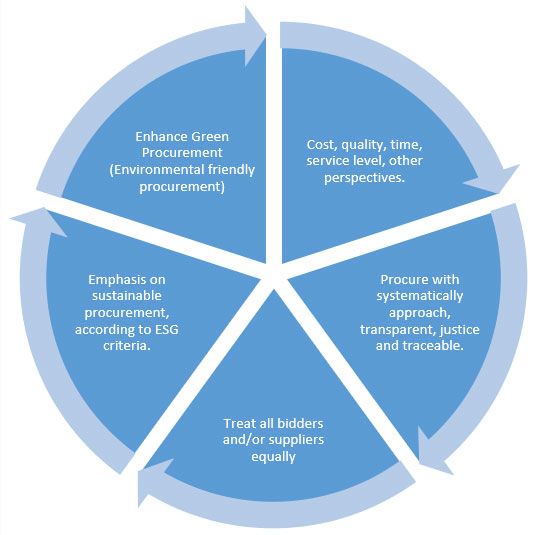
GPSC Group's Supply Chain Management Strategy is established, endorsed, and aligned to make an operating framework which maximizes economic value and minimizes risks for all procurement activities. GPSC Group has announced "GPSC Sustainable Procurement and Supplier Management Policy" in order to conduct business in a fair, sustainable, and accountable manner as well as provide good governance when dealing with communities and environment. GPSC Group's supply chain strategy is implemented by considering 5 main priorities.

Key ESG Objectives Integration in the Supply Chain Strategy
Auditing, planning, monitoring and providing advice on sustainable supplier development

GPSC encourages suppliers to adopt sustainable practices through a post-assessment follow-up activity. This initiative targets partners who have received a sustainability assessment score of less than 2.5 points, as well as those interested in enhancing their ESG performance or implementing corrective actions and recommendations suggested by GPSC. Eligible partners can participate in the program, where GPSC will provide support in developing a sustainable development plan, offering guidance, and closely monitoring progress.

GPSC will monitor all partners participating in the sustainable supplier development program according to the plans they have submitted. Monitoring will be conducted monthly and quarterly by external assessors through online channels. Suppliers can submit data or supporting evidence for their actions to the external assessors for review. GPSC and external assessors will provide consultation and follow-up until partners meet the expected criteria.

  • Offline/Online Assessment
  • Monthly and/or quarterly
  • External assessor
Supplier day

GPSC hosts an annual Supplier Day to connect with its valued suppliers and keep them informed about significant developments, company updates, and initiatives related to sustainable supplier development. This event takes place regularly during the third and fourth quarters of each year. In 2024, the Supplier Day was held on November 13, 2024, with both in-person and online participation.

Supplier information/trainings

GPSC conducts the supplier day for providing information/trainings on company's supplier ESG program, process and requirements. These sessions were conducted on 13 November 2024 with more than 350 suppliers participated through Onsite and online channel under the concept of “CLEAR Procurement for Sustainable Growth”

Supplier access to ESG benchmarks against peers

GPSC has developed the peer benchmarking information platform for providing an opened performance information on specific areas and case studies for improving the supplier ESG performance. Moreover, suppliers can request more detailed information form GPSC for the more specific information for more insight.

ESG Data support

GPSC further supports its suppliers s' sustainability journey by providing access to benchmark data from leading companies in similar or related industries. This allows partners to learn from best practices and implement them within their own operations. Additionally, GPSC is committed to providing tailored support and guidance to partners seeking to enhance their sustainability efforts in other areas.

Supplier support on corrective/improvement actions

GPSC supports, both remote and on-site, suppliers on implementation of corrective/improvement actions in term of keeping monitoring their performance and giving feedback for further improvement

To enhance Green Procurement Policy and build organization wide awareness in suppliers

GPSC Group places emphasis to increase green procurement within value chain.Therefore, GPSC Group applies green procurement in the supply management system and increase our spending with green procurement within the organization. In addition, GPSC Group encourage suppliers to adopt Green Procurement Policy and build awareness on green procurement in their operations to support a purchase of goods or services that impose less environmental burden than the ones performing the same functions. The Green procurement considers the effect of the goods/service throughout its life cycle, spanning from design, procurement of raw materials, production method, packaging, transportation, usage, to disposal after use in order to maximize resource efficiency. Moreover, GPSC Group is planning to integrate green procurement aspect as part of supplier selection in the future which can also fulfill our supply chain strategy and vision effectively.

Additionally, GPSC Group encourages suppliers to get certification for Green Industry (at least Level 2 or equivalent Green Activities) according to Green Industry Standard by Ministry of Industry Thailand, in which the supplier shall have environmental policy, conduct sustainable resource use, conduct climate change mitigation and adaptation as well as protect and restore of the natural environment.

To enhance awareness of GPSC supplier Code of conduct

GPSC Group place emphasis on sustainable procurement by integrating ESG into supply chain management system. Thus, GPSC Group enhances an acknowledgement and awareness of GPSC supplier Code of conduct to enhance transparency, fairness, and efficiency in suppliers in order to get products or services that meet the desire outcomes. Suppliers that comply with supplier code of conduct are considered in the GPSC supplier selection process as part of ESG evaluation.

Green Procurement Guideline
Green Procurement

GPSC aims to use products and services that minimize environmental impacts by implementing the Procurement Policy which requires environmentally friendly procurement practices. Specifically, the consideration of the environmental friendliness of a product or service spans the entire life cycle from obtaining raw materials to managing products past the expiration dates.

Local procurement

GPSC supports local procurement within Thailand, which brings both direct and indirect benefits to the company. The direct benefits of local procurement are lower costs and faster transportation which directly affect the company's procurement efficiency. Moreover, the company also gains indirect benefits by supporting a local economy and creating jobs and income for local residents. The goodwill created by this process helps strengthen relationships with local communities which, in turn, engenders trust for the company.

SUPPLY CHAIN KPIs

KPIs FOR SUPPLIER SCREENING 2024
PERFORMANCE
1.1 Total number of Tier-1 suppliers 1,017
1.2 Total number of significant suppliers in Tier-1 39
1.3 % of total spend on significant suppliers in Tier-1 92%
1.4 Total number of significant suppliers in non Tier-1 1
1.5 Total number of significant suppliers (Tier-1 and non Tier-1) 40
KPIs FOR SUPPLIER ASSESSMENT 2024 2024
PERFORMANCE TARGET
1.1 Total number of suppliers assessed via desk assessments/ on-site assessments* 39 (100%) 39 (100%)
1.2 % of significant suppliers assessed 100% 100%
1.3 Number of suppliers assessed with substantial actual/ potential negative impacts 3 3
1.4 % of suppliers with substantial actual/potential negative impacts with agreed corrective action/improvement plan 100% 100%
1.5 Number of suppliers with substantial actual/potential negative impacts that were terminated 0 0

Note : - From the assessment of suppliers' sustainability potential (Comprehensive ESG Assessment) found that suppliers that can increase their sustainability potential In the areas of environment, society and governance, a total of 11 cases. All partners have been pushed into the development and improvement plans, with 7 having already completed the process and 4 in the process of implementing the plan.

KPIs FOR SUPPLIER WITH CORRECTIVE ACTION PLANS 2024 2024
PERFORMANCE TARGET
2.1 Total number of suppliers supported in corrective action plan implementation* 3 3
2.2. % of suppliers assessed with substantial actual/potential negative impacts supported in corrective action plan implementation 100% 100%
KPIs FOR SUPPLIER IN CAPACITY BUILDING PROGRAMS 2024 2024
PERFORMANCE TARGET
3.1 Total number of suppliers in capacity building programs* 66 66
3.2 % of unique significant suppliers in capacity building 100% 100%

Note:

  1. - * For suppliers which were identified as significant in the supplier screening process.
  2. - Conduct audits of suppliers on environmental, social and corporate governance (ESG) issues by external agencies using remote auditing methods.
Updated as of February 2025

The above content is prepared in accordance with the sustainability reporting standards by the Global Reporting Initiative (GRI Standards), which is validated by external parties and provides a limited level of assurance of reporting information (Limited Assurance).